



Value to Our Future: Sustainable and Livable World
Combating Climate Change and Environmental Compliance
The global economy is being reshaped around carbon pricing mechanisms and ETS, making the fight against climate change a financial imperative. Aligned with the EGD and the CBAM, interconnected global carbon markets are directly affecting the cost structures and competitiveness of the real sector. In this context, the banking sector must manage not only physical climate risks but also transition risks arising from customers’ carbon-related costs. International sustainability standards and ESG criteria play a decisive role in capital allocation, while financial institutions are transforming their portfolios in line with Net-Zero commitments.
The Climate Law, which entered into force in 2025 as a legal milestone in Türkiye’s green transformation journey, and the Turkish ETS to be established under this framework, are accelerating the transition to a low-carbon economy. While the Climate Law legally anchors emission reduction targets, the Turkish ETS mechanism transforms carbon into a tradable asset or liability for industrial enterprises.
Ziraat Bank aims to ensure full compliance with the regulations introduced by the Climate Law and ETS processes, to support its clients’ adaptation to these new market dynamics, and to facilitate their carbon management practices through the sustainable finance solutions it provides.
With the strength and responsibility derived from its 162-year history, the Bank plays an active role across all areas-from combating climate change to protecting natural resources-and continues to create value for the future by taking decisive steps today toward a more livable world.
The Bank's sustainability approach is shaped by a holistic perspective that encompasses its responsibilities towards the environment, customers, society, and employees; economic sustainability goals are implemented with consideration for environmental and social impacts. The Bank has placed the climate crisis and the transition to a zero-carbon economy at the center of its strategic priorities; it manages resources and infrastructure to create a value chain aligned with the UN SDGs.
Ziraat Bank's main goal in this process is to contribute to the environment, economy, and society in line with its Sustainability Policy, updated in accordance with Türkiye's 2053 Net-Zero Target, and responsible banking principles. With its roadmap focused on climate risk management, the Bank contributes to Türkiye's Net-Zero Emissions Target and the Paris Climate Agreement's goal of limiting global temperature increase to 1.5°C. It focuses on growth through economic, environmental, social, and governance practices to achieve SDGs.
More information about developments in the sustainability agenda and Ziraat Bank's actions can be found in the Developments in the Sustainability Ecosystem section.
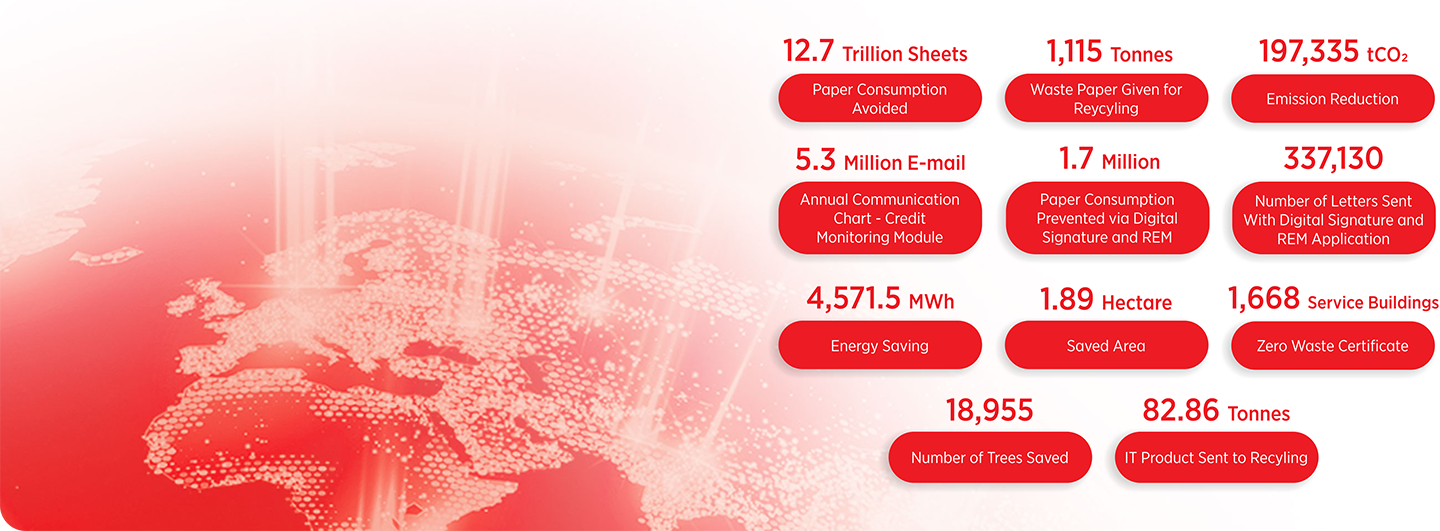

Within Ziraat Bank, efforts to combat climate change are carried out under the coordination of the Project Finance and Sustainability Department and with the participation of all business units of the Bank. In this context, domestic and international legislation, regulatory developments, and best market practices are closely monitored, and initiatives aligned with the business model of the Bank and the ZFG are implemented accordingly.
Environmental Compliance
Ziraat Bank considers effectively managing the environmental impacts arising from its activities, addressing the risks posed by climate change through strategic approaches and technological solutions, and ensuring continuous improvement in this area to be among its top priorities. In line with this, the Bank regularly monitors its environmental performance in its operational processes and carries out activities aimed at improvement.
The Bank measures greenhouse gas emissions generated throughout the service cycle and develops applications to reduce them. It aims to contribute to international targets of keeping the global temperature increase below 2°C by promoting the efficient use of energy and other natural resources. Priority is given to local and renewable sources in meeting energy needs, and the share of renewable energy is targeted to be increased through investments in this area.
As part of its environmental approach, and within the scope of protecting water resources, Ziraat Bank evaluates the risks associated with water-dependent sectors and operates with a perspective that prioritizes the sustainable management and accessibility of water resources.
The Bank conducts its activities in full compliance with applicable environmental legislation and standards in Türkiye and also undertakes initiatives to promote globally recognized best practices in the other countries where it operates.
Acting in collaboration with its stakeholders to enhance environmental awareness, Ziraat Bank addresses climate and water-related risks within the framework of international standards and integrates these risks into its decision-making processes. In addition to efforts aimed at reducing the environmental impacts arising from its own operations, the Bank develops its banking products and services in line with the principles of sustainable development, and supports investments in sustainable agriculture, renewable energy, and environmental protection through its financial resources.
As of 2025, the establishment of the Environmental Management System within Ziraat Bank has been completed. The system has been structured to support the monitoring of environmental impacts, ensure legal compliance, and promote a culture of continuous improvement at the corporate level. The certification process under the ISO 14001 standard is planned to be completed in 2026, with the aim of further maturing practices and monitoring their effectiveness.
To support environmental compliance at the operational level, the Bank is expanding the use of electronic document management, e-signature, e-archive, digital receipts, and digital card applications, thereby limiting the consumption of natural resources through reduced paper and plastic usage. In operational processes, physical printouts are increasingly replaced by digital review and on-screen verification practices, contributing to the reduction of environmental impacts.
Practices at Subsidiary Level
In the countries where the Bank’s subsidiaries operate, efforts to combat climate change include the widespread implementation of thermal insulation in service buildings, the use of energy-efficient lighting systems, and the adoption of technologies with low energy consumption. Alongside these initiatives, recycling and waste reduction activities are ongoing, with particular measures taken to prevent methane emissions. In order to protect natural areas and support ecosystems, certain subsidiaries organize initiatives aimed at increasing green spaces, protecting forests, and promoting afforestation. Furthermore, in line with the economic and legal policies implemented by the competent authorities in the countries where the subsidiary banks operate to address climate change, product development efforts are carried out to encourage environmentally friendly investments. At the same time, climate-related training and awareness-raising activities are conducted for employees.
Sustainability and Environmental Training
Ziraat Bank places significant importance on capacity building in its fight against climate change. Climate crisis, sustainability, and environmental-themed e-learning programs, classroom training, and webinars are organized for employees. Sustainability and climate change training are also provided to newly hired employees during the orientation process. In addition, employees of the relevant department participate in certification programs in the field of sustainability. For agricultural clients, awareness-raising activities are conducted on the impacts of climate change, sustainable agricultural practices, and green technologies.
Within this scope, a webinar titled “The Meaning and Opportunities of Climate Change for Banks” was organized for branch managers, with 756 managers participating in the training. Furthermore, the Head of the Project Finance and Corporate Analysis Group completed the Basic Training on the EGD and Türkiye’s Alignment with the EGD, and the certification process was successfully finalized.
To disseminate corporate awareness across the entire organization, all employees were provided with e-learning programs on Zero Waste and the Environmental Management System (ISO 14001 - Environmental Management System and Environmental Drill). In addition, a webinar titled “Introduction to Sustainability for Bankers” was delivered, which was successfully completed by 94 authorized employees working in branches.
Moreover, in order to enhance institutional competencies in sustainable finance and climate-friendly investment models, a training program on Renewable Energy and New Investment Models was organized. A total of 114 participants, including the Group Head, Department Heads, and Unit Managers within the Project Finance and Corporate Analysis Group Directorate, completed this training.
Developments in the field of climate and sustainability at both national and international levels are closely monitored, and participation is ensured in workshops, trainings, and conferences organized by relevant institutions, particularly the Public Oversight Authority and BAT. Ziraat Bank supported the International Zero Waste Forum held in Istanbul between 17-19 October 2025, themed “Zero Waste Movement: People, Place and Transformation.”


Environmental Investments
Compared to 2024, the total amount of resources allocated to environmental investments increased by 282% in 2025.
Ziraat Bank continues to carry out infrastructure and improvement investments to support its initiatives aimed at reducing environmental impacts. In this context, the total resources allocated to environmental investments in 2025 increased by 282% compared to 2024. These investments support the Bank’s environmental management approach in line with its objectives of enhancing resource efficiency and strengthening environmental performance.

Digitalization-Focused Practices and Operational Transformation
As of 2025, digitalization-focused initiatives have gained significant momentum within the scope of combating climate change. To reduce the use of physical documents, digitally signed statements have been introduced and delivered to customers electronically, thereby contributing to environmental sustainability by reducing paper consumption and operational workload.
Through the use of artificial intelligence and OCR technologies in the Operational Center processes, processing instructions are read and handled automatically, reducing manual controls, shortening processing times, and improving energy efficiency. The transition of processes to digital channels across the Bank has reduced branch visits, while services provided via internet banking and mobile channels have contributed to lowering transportation-related carbon emissions.
In legal processes, the widespread use of Registered Electronic Mail (REM), e-freelance invoice, and e-invoice has reduced reliance on paper, significantly lowering operational costs and the carbon footprint.
AI-supported robotic control activities, initiated as a pilot project in 2024, were expanded in 2025 and scaled across the Bank. Through centralized control from headquarters, robotic monitoring, real-time credit tracking, and diversified scenario-based analytical controls, the number of on-site branch inspections has decreased significantly.
As a result of this transformation, the need for business travel, vehicle usage, and hotel accommodation within the scope of control and audit activities has declined, leading to a reduction in greenhouse gas emissions arising from the Bank’s operations. The centralization of operational processes through digitalization and advanced analytics has contributed to the reduction of indirect emissions within the framework of climate change mitigation.
As of 2025, efforts to reduce environmental impacts through digitalization-focused initiatives continue. In this context, the digital slip application has been implemented to reduce paper consumption and enhance resource efficiency in transaction processes. Additionally, sustainability enhancement projects for the digital credit card and the Bankkart Başak Agricultural Card are ongoing. Through the digital credit card project aimed at reducing plastic card usage, the Bank seeks to mitigate production- and logistics-related environmental impacts while offering customers more environmentally friendly payment solutions.
In order to protect natural areas and support ecosystems, certain subsidiaries organize initiatives aimed at increasing green spaces, protecting forests, and promoting afforestation. Furthermore, in line with the economic and legal policies implemented by the competent authorities in the countries where subsidiary banks operate to address climate change, product development efforts are carried out to encourage environmentally friendly investments, while climate training and awareness-raising activities are conducted for employees.