



Sustainability Journey
Sustainability Governance and Organization
Ziraat Bank focuses on placing sustainability at the center of its strategic decisions across the entire value chain, developing its practices, and ensuring that sustainability remains an integral part of its corporate culture. The Bank's approach to sustainability is shaped in an integrated manner within the framework of its responsibilities towards the environment, society, its customers, and its employees. The Bank addresses economic sustainability as one of its core values, in line with environmental and social responsibility principles.
In this context, short, medium, and long-term goals are set taking into account environmental and social risks and opportunities; resources and service infrastructure are managed within this framework. Combating the climate crisis and transitioning to a zero-carbon economy are among the Bank's top priorities. Accordingly, financial support is provided to projects developed in the areas of energy efficiency, renewable energy, circular economy, and efficient mobility. Service processes are continuously improved with a focus on sustainability; banking products and services are offered to all customers in practical, accessible, and digital formats.
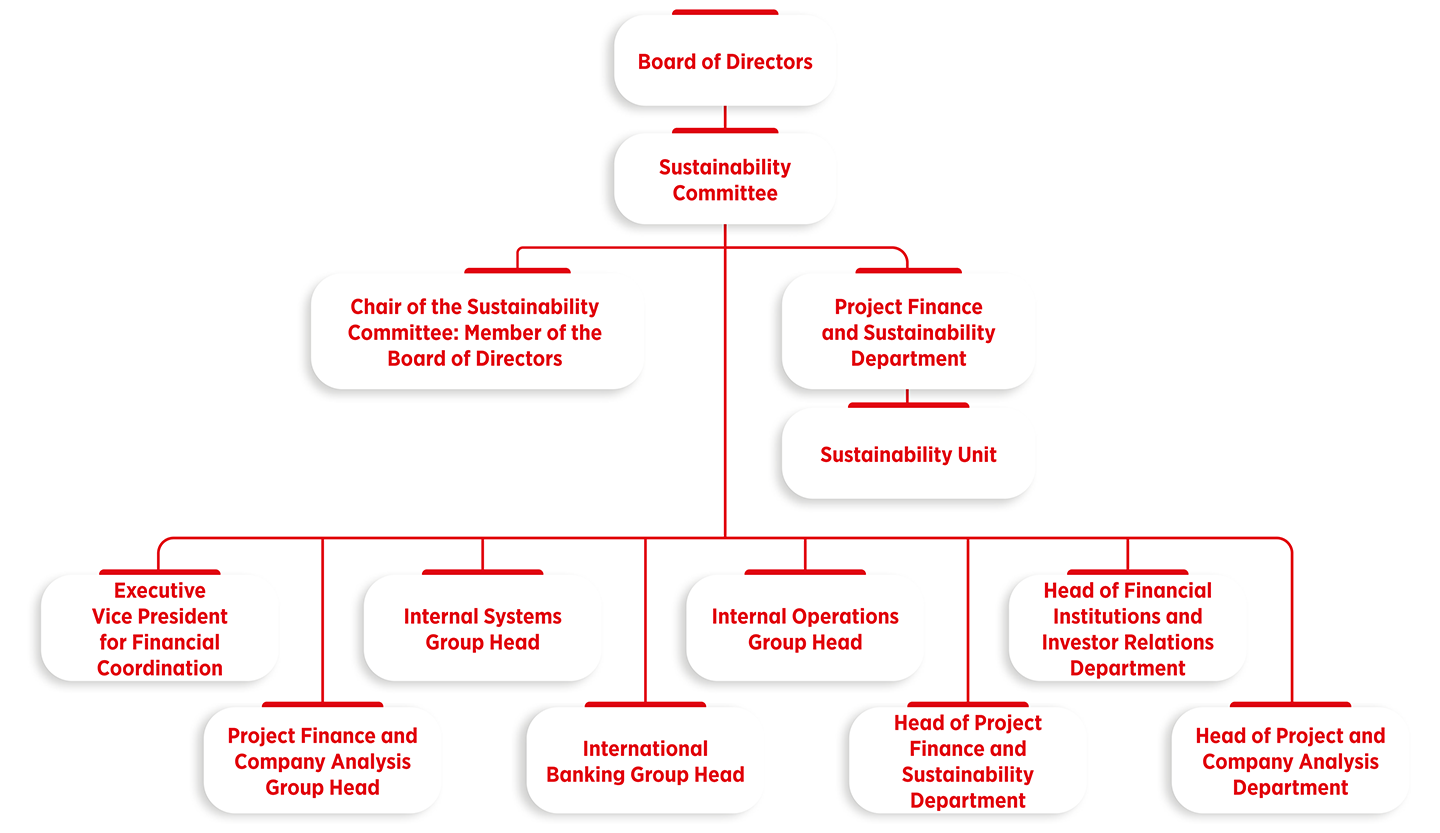
At Ziraat Bank, the management of sustainability and climate-related risks and opportunities is carried out under the supervision of the Board of Directors at the highest level. The Bank's sustainability management organization is based on a holistic structure that integrates economic, environmental, and social dimensions. Within this framework, the Bank's sustainability strategy and roadmap are developed under the guidance and supervision of the Board of Directors and implemented across the Bank through a lean, effective, and integrated governance structure. At the heart of this governance structure is the Sustainability Committee, established in March 2023.
The operational coordination of sustainability efforts has been carried out since 2022 by the Project Finance and Sustainability Department, which operates under the Project Finance and Corporate Analysis Group. In this context, individuals responsible for sustainability have been identified across the Bank and involved in the relevant processes to ensure the widespread implementation of practices at the corporate level.

Sustainability Committee
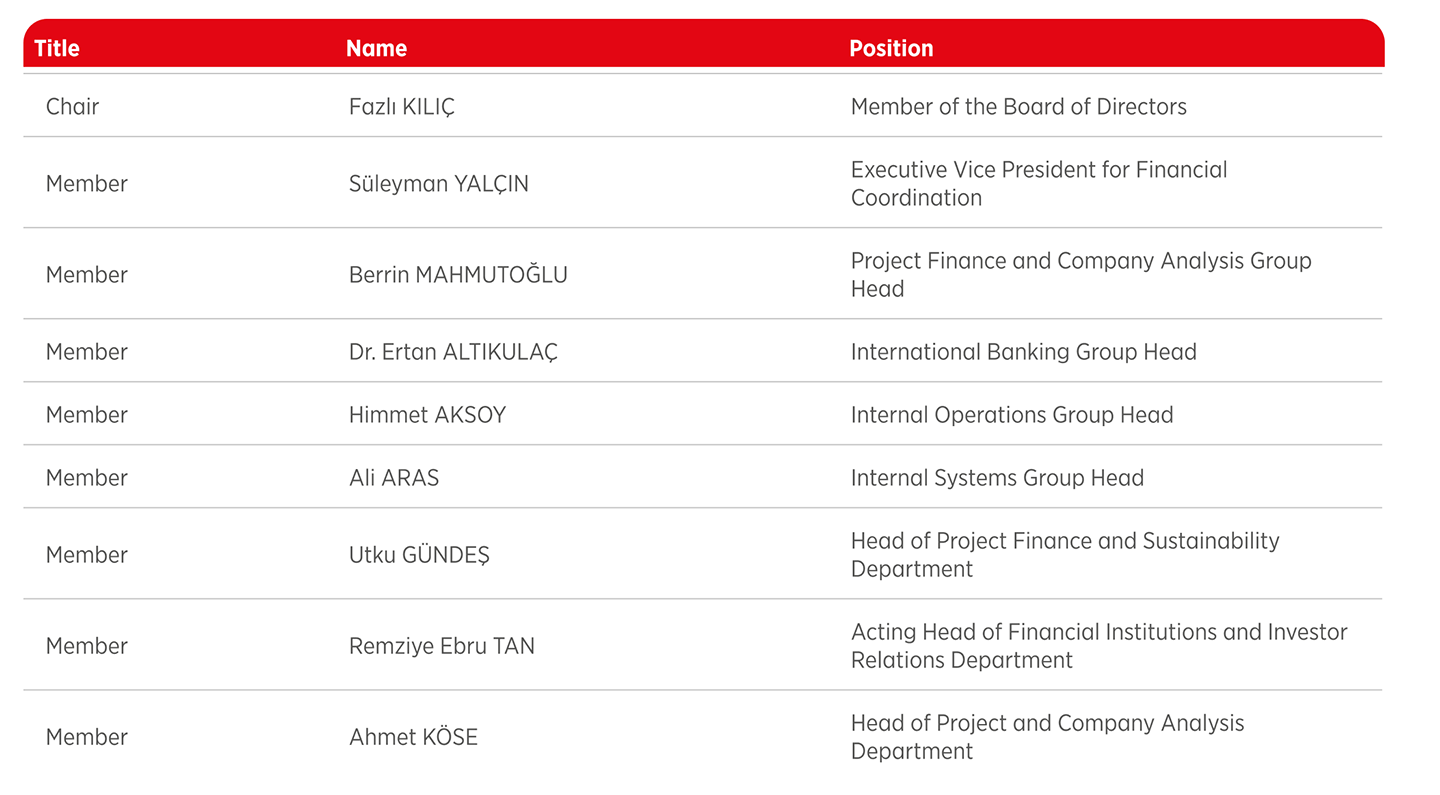
Established in 2023 under the chairmanship of a Board Member, the Sustainability Committee is responsible for coordinating the processes of developing, implementing, monitoring, and reporting on the sustainability strategy across the Bank. The Committee aims to ensure the adoption of the sustainability vision throughout the institution and to integrate ESG-related policies, strategies, and practices into the corporate strategy. Increasing sensitivity to stakeholder expectations and strengthening compliance with national/international standards are also among the Committee's priority focus areas. The Committee chair is appointed from among the Board of Directors members.

Duties and Responsibilities of the Sustainability Committee
The Chair of the Sustainability Committee is appointed from among the members of the Board of Directors, and the results of the Committee's activities are reported to the Board of Directors once a year. To ensure the effectiveness of its work, the Committee met four times in 2025 and made 13 decisions. The secretarial duties for Sustainability Committee meetings are carried out by the Project Finance and Sustainability Department.


Experience of Committee Members Responsible for Sustainability Management
Ziraat Bank Board Member and Chairman of the Sustainability Committee Fazlı KILIÇ graduated from the Department of Business Administration and Accounting at the Faculty of Commercial Sciences, Istanbul Academy of Economic and Commercial Sciences in 1980. In 1982, he completed his master’s degree in accounting Audit Specialization at the Faculty of Business Administration, Istanbul University. He has 26 years of experience as a Certified Public Accountant. He served as a Member and Group Chair of the Istanbul Provincial Assembly between 1994 and 1999, and as Mayor of Kağıthane for three terms between 2004 and 2019. Board Member Mr. Fazlı KILIÇ chairs the Sustainability Committee established by Ziraat Bank in March 2023.
Sustainability Committee Member Berrin MAHMUTOĞLU graduated from Istanbul University Faculty of Economics. She started working as an Assistant Financial Analyst at T. Emlak Bank in 1996 and later worked at Körfezbank. She served as Corporate Marketing Manager at Bank Pozitif Credit and Development Bank. Mahmutoğlu has been Project Finance Manager at Ziraat Bank since March 2013, when the Project Finance Department was established. She served as Head of the Project Finance Department from September 2017 to July 2022 and spearheaded the establishment of the Sustainability Unit within Project Finance in 2022. He has continued to serve as Head of Project Finance and Company Analysis Group since July 2024. Since 2023, he has been one of the founding members of the Sustainability Committee, guiding Ziraat Bank's strategic decisions related to sustainability. An experienced leader in project finance, sustainability, and structuring, Mahmutoğlu manages the financing of mega projects on behalf of Ziraat Bank, which makes significant contributions to Türkiye's sustainable development, and works on sustainable financial solutions for projects. Berrin Mahmutoğlu has served as the Chair of the Board of Directors of Ziraat Finansal Yatırımlar A.Ş. since 2022.
Sustainability Competence
The bank systematically conducts training, certification, and capacity development activities aimed at increasing the knowledge and awareness of its employees in order to strengthen its corporate competence in the field of sustainability. These activities aim to deepen corporate knowledge on climate change, environmental risks, and sustainable finance, and to increase the expertise of the relevant units.
• As part of the fight against climate change, awareness and training activities have been carried out on sustainability, increasing energy efficiency, reducing resource consumption, and promoting waste management and recycling practices.
• A webinar titled “The Meaning and Opportunities of Climate Change for Banks” was organized for branch managers, with 756 managers participating in the event. The Head of Project Finance and Company Analysis Group obtained the European Green Deal (EGD) and Türkiye's EGD Compliance Basic Training certificate. In addition, e-learning courses on Zero Waste and Environmental Management System (ISO 14001) were offered to all employees
• A training session on Renewable Energy and New Investment Models was organized, attended by the Head of Project Finance and Company Analysis Group, the Head of Project Finance and Sustainability Department, the Head of Company Analysis Department, and managers working in these units.
• Employees of the Project Finance and Sustainability Department and the Project and Company Analysis Department, who are involved in sustainability efforts within Ziraat Bank, have earned the Sustainability Expertise Certificate by participating in the Sustainability Expertise Certificate Program organized in collaboration with the Turkish Capital Markets Association (TSPB) and Sustainable Learning, Development and Excellence Association(SEGM).
• In 2025, new personnel were hired within the Project Finance and Sustainability Department, strengthening the team structure. In this context, the unit aims to fulfill its duties and responsibilities more effectively and efficiently.
Activities Conducted Regarding Climate and Sustainability Risks and Opportunities
At Ziraat Bank, SMS has been implemented as of 2025. Through this system, carbon and water footprint data and ESG indicators from all departments across the Bank are collected and reported through a centralized and systematic structure. SMS is actively used to monitor and evaluate the Bank's sustainability performance and to support forward-looking planning efforts. Within the scope of the system, Environmental Management System processes have also been completed, and related ISO certification efforts have been implemented.
The data infrastructure created within the scope of SMS enables the measurement and monitoring of climate-related risks and opportunities and their integration into risk management processes.
The Risk Management Department is responsible for identifying, measuring, and monitoring climate-related financial risks. Heat map studies were conducted on a sectoral basis to assess the Bank's portfolio's exposure to climate risks, and sectors with high risk levels were identified. Scenario-based stress tests were applied to these sectors to calculate possible changes in expected credit losses. Heat map studies were conducted on a sectoral basis to assess the bank's portfolio's exposure to climate risks; sectors with high risk levels were identified. Scenario-based stress tests were applied to these sectors to calculate possible changes in expected credit losses. Risk appetite metrics monitored in relation to the financial impacts of climate risks are reported to the Risk Committee by the Head of Risk Management on a quarterly basis and to senior management on a monthly and quarterly basis.
In 2025, heat map studies are being revised in parallel with updated national and international sources; the parameters used in stress tests and scenario analyses are also being updated accordingly. In the same year, Ziraat Bank has implemented reporting in line with the TSRS standards published by the POA; the work carried out has been expanded to cover the entire ZFG.
As of 2025, Ziraat Bank has begun implementing practices to monitor the relationship between climate and sustainability risks and traditional risk types.
In this context, climate risk-specific limits were defined with the approval of the Board of Directors for loans granted to the two sectors with the highest risk level on the Bank's climate risk heat map, and climate risk calculations were initiated for these loans. Potential impacts are regularly monitored through the defined climate risk limits, and the results obtained are integrated into risk management processes. Furthermore, sustainability risks have been incorporated into the ISEDES processes. In this context, the Bank's structure, ongoing work, analyses conducted, and operations have begun to be explained under a separate heading in the ISEDES Report.